Exceeding Expectations
October 26, 2026
Damn, it’s nice to see a climate-related dataviz that shows how humans exceeded expectations and blasted past projections in a positive way.
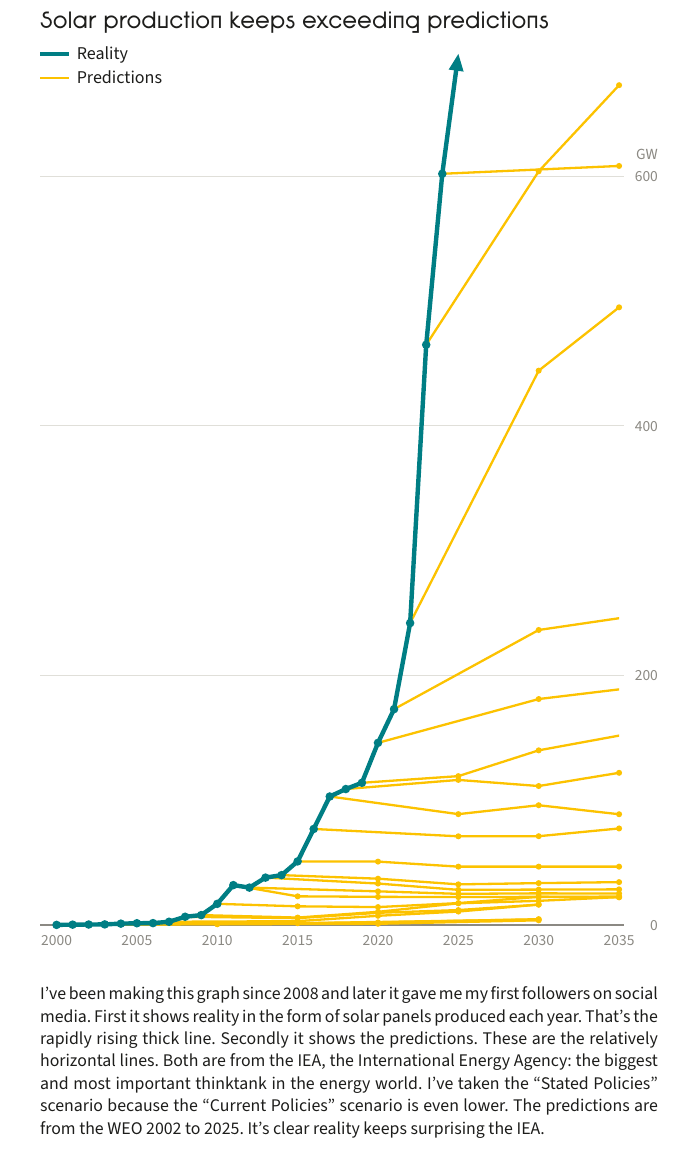
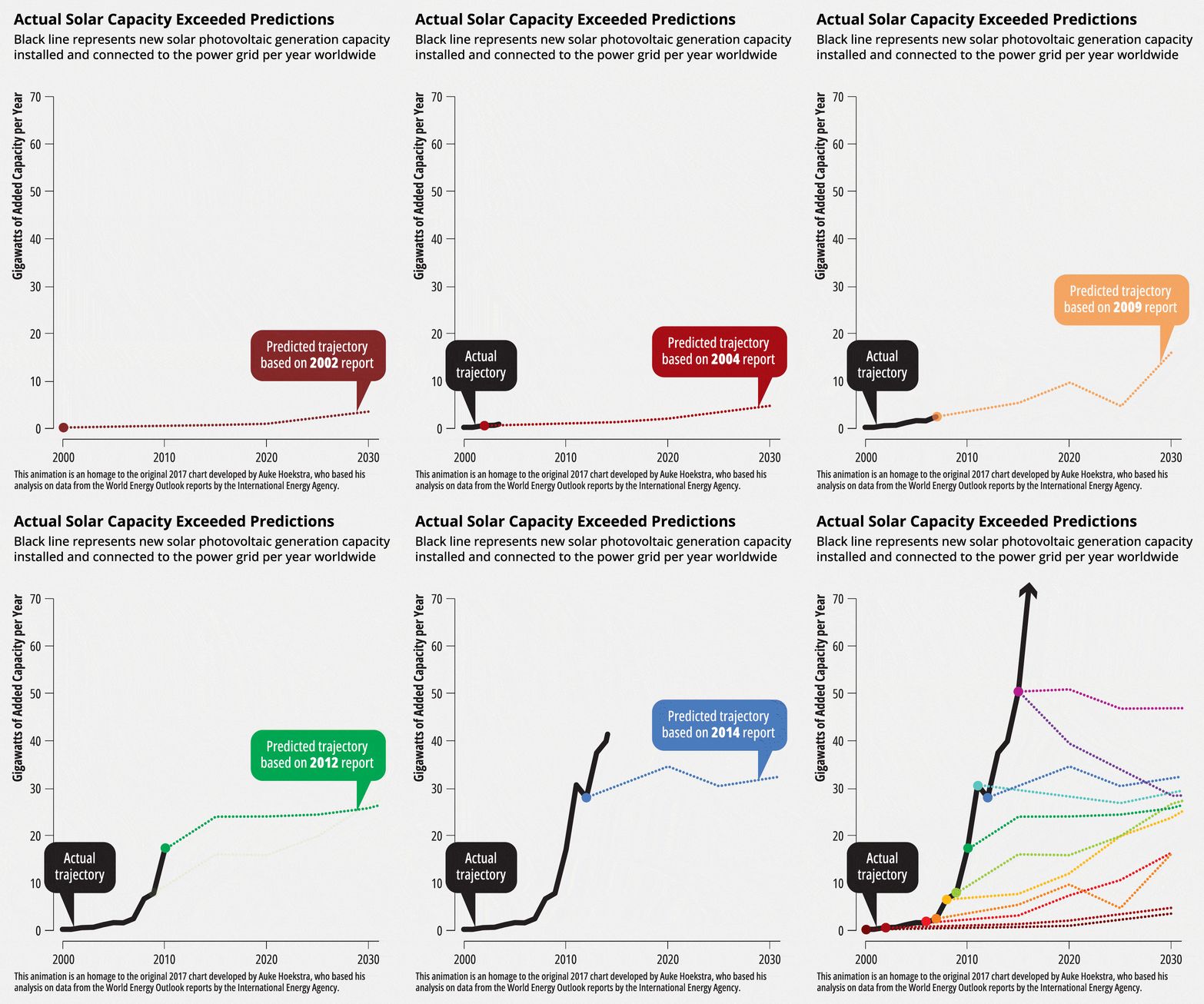
Last week I learned about a chart that illustrates the difference between solar panel capacity predictions and the actual data. Nearly flat/horizontal lines show projections rooted in data from the International Energy Agency’s World Energy Outlook reports. A thicker black line that starts with a gentle curve and then shoots upwards shows actual added capacity of photovoltaics per year. The solar industry is in a full-on sprint, helping us make the shift from carbon-based to renewable energy. (And yes, the celebrated chart is nearly a decade old. I’m a bit sheepish that I wasn’t aware of it earlier. But perhaps it’s new to you, too.)
The analysis and graphic was produced by Auke Hoekstra (currently program director at NEON Research, Eindhoven University of Technology) and posted to Twitter on May 21, 2017. Hoekstra wrote a full breakdown of his process and the data in a June 2017 blog post (updated in 2018), including the chart, plus critiques and rebuttals.
The actual values have continued to skyrocket since 2017. Others have plotted that continued progress.* Here, I offer my contribution to the many homages to Hoekstra’s original. Mine is an animated version of the 2017 edition, in the hopes that putting the chart in motion makes it more intuitive to read.
*After this post went live, Auke Hoekstra kindly shared a more recent version of his chart, along with permission to publish it here (below).