Social Influence and Action
October 10, 2026
I’m wary of climate solutions that are hyper focused on the action of individuals as opposed to systems and corporations. Do you experience carbon footprint guilt every time you board a plane to visit family too? Well, that whole schema was a product of the PR firm Ogilvy & Mather for British Petroleum. It was an effort to shift focus away from oil companies and onto individual responsibility to lower greenhouse gas emissions. For more, read “The carbon footprint sham” by Mark Kaufman for Mashable in 2021, and “Big oil coined ‘carbon footprints’ to blame us for their greed. Keep them on the hook” by Rebecca Solnit for The Guardian.
But I’m also hungry for information about how people think about—and relate to—the climate crisis. After all, systems are influenced by individuals and corporations are led by humans.
A recent paper published in Nature Climate Change on the topic of social influence caught my attention. As Sam Hampton and collaborators put it,
“In the context of climate change, social influence operates across multiple domains, shaping conversations, consumer decisions, professional practices and political engagement. It can originate from a range of actors, from celebrities and policymakers to community leaders and family members.”
They propose a mental model to guide communication strategies. Here’s my graphical interpretation of their proposed framework:
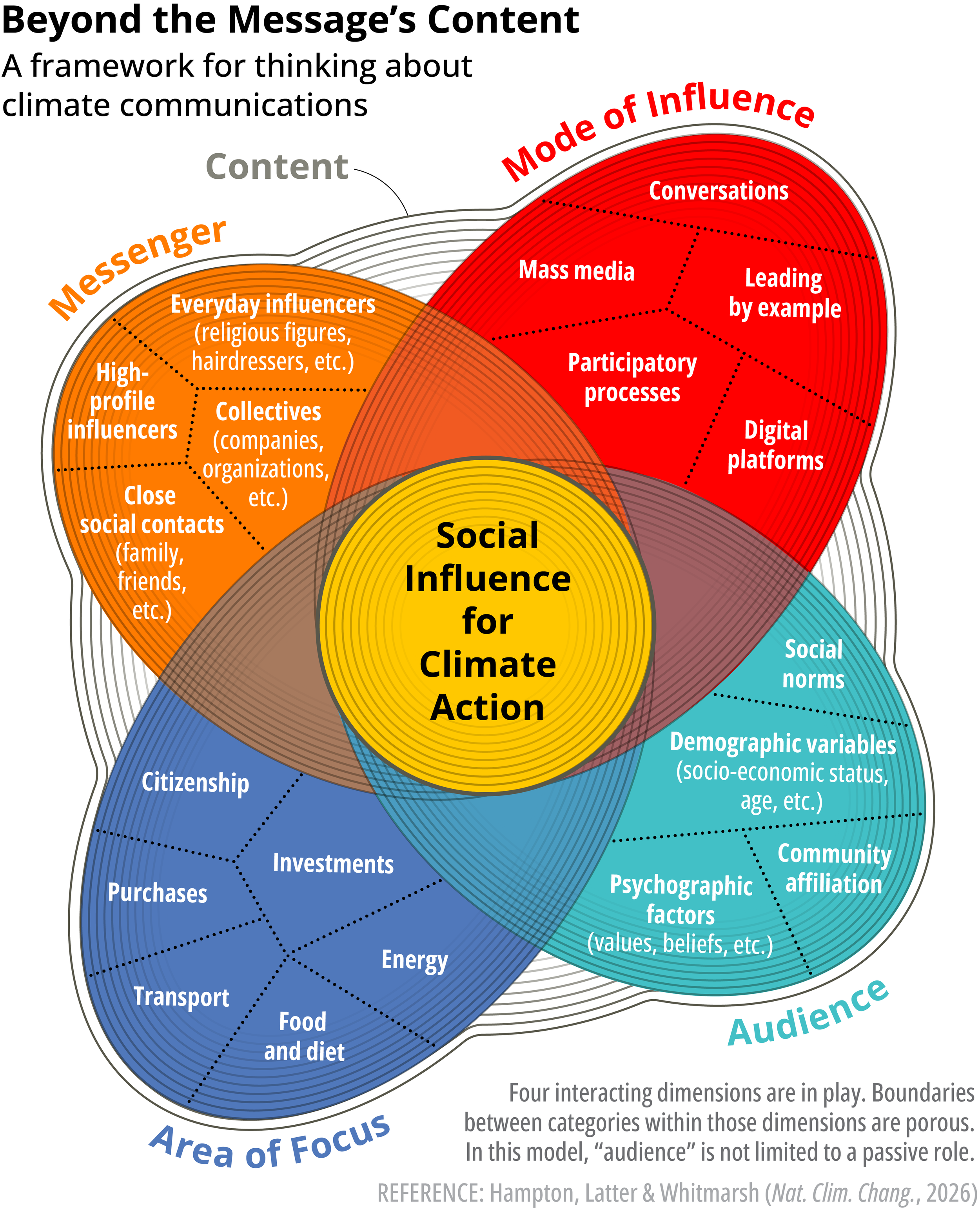
The framework isn’t very surprising to me. In fact, it echoes a lot of what I’ve learned about the science of science communication. But I’m in favor of any tool that prompts me to be more thoughtful and intentional about sharing and receiving information. So, I'm adding the paper to my reference file, and listening more keenly to everyday influencers.