Correcting Misperceptions
November 24, 2026
We're underestimating each other.
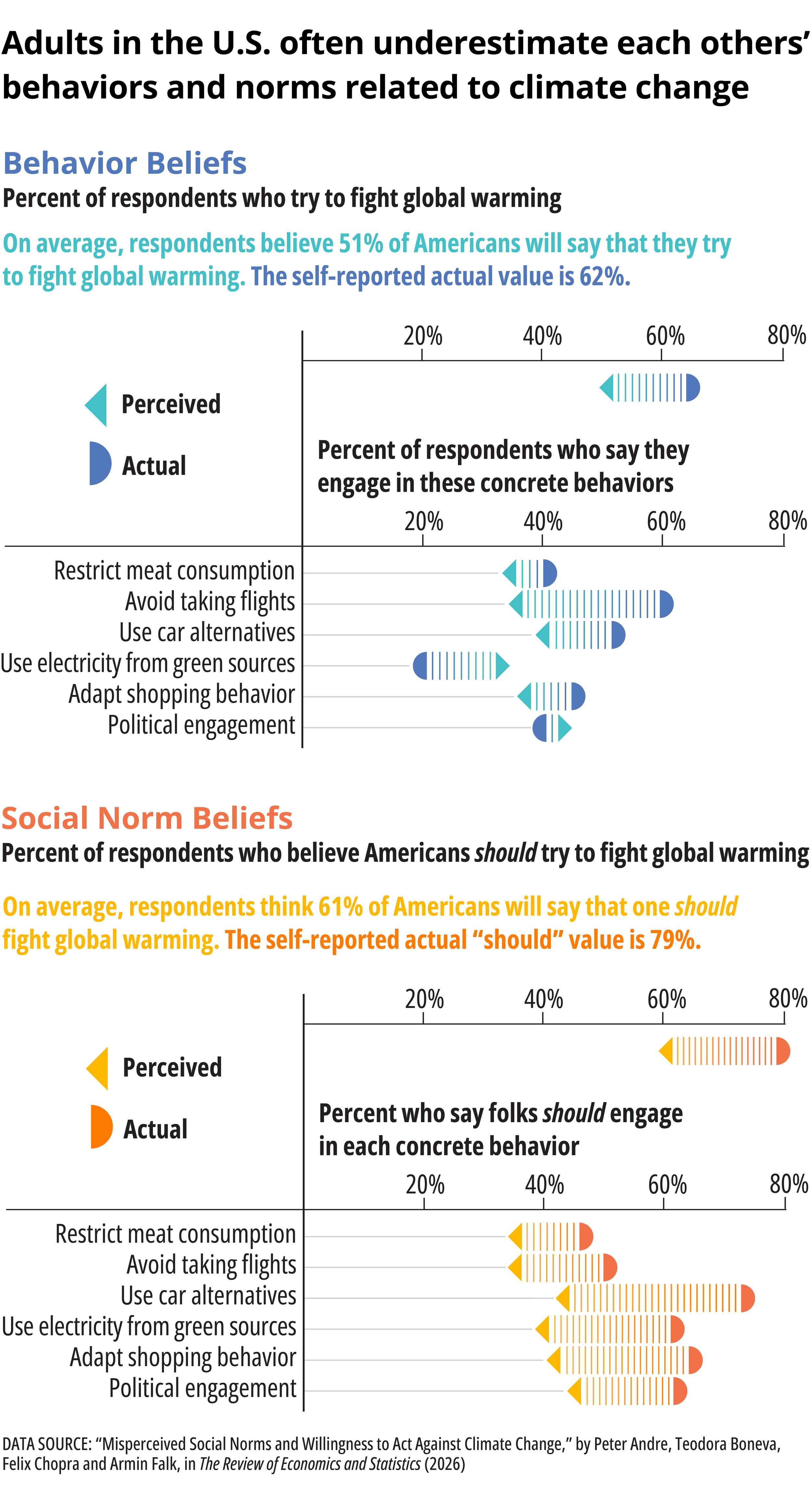
At least that's the case when it comes to perceiving the willingness of our fellow humans to donate to causes that support climate action. For more details, see the charts in my previous post based on a 2024 article by Peter Andre, Teodora Boneva, Felix Chopra and Armin Falk.
In a follow up study published in 2026, the same researchers explore what happens when you correct those misperceptions. The results are encouraging.
Their experiment addresses the power of social norms. Per the authors, social norms “represent behavioral rules that express which behavior is considered common and normatively acceptable,” and “can exert a strong influence on individuals’ attitudes and behaviors, potentially creating substantial momentum either in favor of or against climate action. Whether or not social norms can unleash a positive momentum crucially depends on how social norms are perceived.” (The authors are quick to note that their research builds on substantial work by others on the topic of social norms, sustainable behavior, and political polarization.)
In a nutshell, 8,000 people participated in one of two survey waves. In the first wave the researchers collected a bunch of information that helped establish actual behaviors and norms and how each of the participants perceived other people’s behaviors and norms around climate action.
The second wave was an experiment in which adults in the U.S. were given a hypothetical $450. They could pocket some, and then the rest would go to a charitable organization that fights global warming. To help keep things real, a random sampling of those folks would have their choices implemented. The donation is a proxy to help ascertain willingness to act against climate change.
In the control group, participants started with a question to test their level of attention and then moved on to a donation decision. Two other groups got more information before their donation decision: One was presented with the self-reported actual behavior data from wave 1, and the other was presented with the self-reported norms data from wave 1. All also answered a series of questions about policy support, political engagement and perceived norms.
On average, survey respondents were willing to donate $225 of the $450 to a charitable organization that fights global warming. Notably, people who were presented with information on others’ self-reported climate-related behavior and norms were more likely to give more money.
Exposure to top-level behavior survey information—62% of survey respondents said they try to fight global warming—was associated with a $12 increase in donation value.
Exposure to top-level social norm survey information—79% of survey respondents think Americans should try to fight global warming—was associated with a $16 increase in donation value.
Further, “the effects are strongest for individuals who are skeptical about the existence and threat of global warming.” (Check out the full paper for a breakdown of different variables.)
This is your sign to ignore the adage that you should tread lightly when talking about topics that feel remotely political at holiday gatherings. Speak up about your commitment to a sustainable future!
But before diving in, maybe watch a four minute video by Alliance for Climate Education based on Renée Lertzman’s* work with high school students, in which the secret to talking about climate change is revealed. Spoiler alert: Listen.
===
*Thanks to Renée Lertzman for sharing the video in her guest lecture for a Climate Solutions & Strategies program I'm enrolled in. Also note that Alliance for Climate Education appears to have changed names a few times, and is now GoodPower (formerly also Action for the Climate Emergency).